As an 80’s child, I absorbed humor in neat thirty-minute sitcom bites. Saturday morning cartoons. Three’s Company. Abbott and Costello with my dad. Late-night reruns of The Honeymooners. Slapstick. Subtle. Physical comedy. Razor-sharp Timing. I was surrounded by it.
That early immersion shaped me in ways I didn’t fully understand until much later. I truly believe humor and entertainment are gateways to literacy.
When children laugh, they lean in.
When they are entertained, they turn the page.
And when they turn the page, they are reading—joyfully, willingly, and often repeatedly.
That belief lives at the heart of The Little Press. You’ll notice many of our picture books are character-driven, bright, and infused with humor. It’s where I naturally gravitate as both a writer and a publisher. Humor is not an add-on for me. It’s an engine. But writing humor requires authenticity.
The first time someone told me that I was funny, I was genuinely surprised. I never thought of myself that way. My brother was funny. The men in my life were funny—big, entertaining personalities. I was usually the quiet one.
“Really? I’m funny?”
“Yes,” they said. “You’re witty funny. It’s unexpected. It’s hysterical.”
That comment stayed with me. Not because it labeled me as funny, but because it revealed something about voice. There are physical comedians. There are deadpan comedians. There are masters of timing, understatement, and absurdity. Children’s books are no different. Humor can shout. It can whisper. It can tumble across the page or slip in sideways.
The key is this: be genuine. Be true to your personality. The humor that fits you will fit your story.
As publisher and primary editor at The Little Press—handling both acquisitions and developmental edits—authenticity is the first thing I look for in a humorous manuscript.
Are the jokes organic to the story?
Or are they there simply to get a laugh?
If someone is dropping in a string of random gags or gratuitous “bathroom humor” just for effect, it doesn’t pass the sniff test.
Humor must grow from somewhere real.
Is it jumping off the page like a physical comic?
Is it oozing through unexpected wit?
Is it rooted in narration, dialogue, setting—or perhaps entirely in the illustrations?
And importantly: restraint matters. You don’t need every comedic device firing at once. Too much becomes noise. Choose what serves the story and what feels true to your voice.
Let me share a few examples from our list:
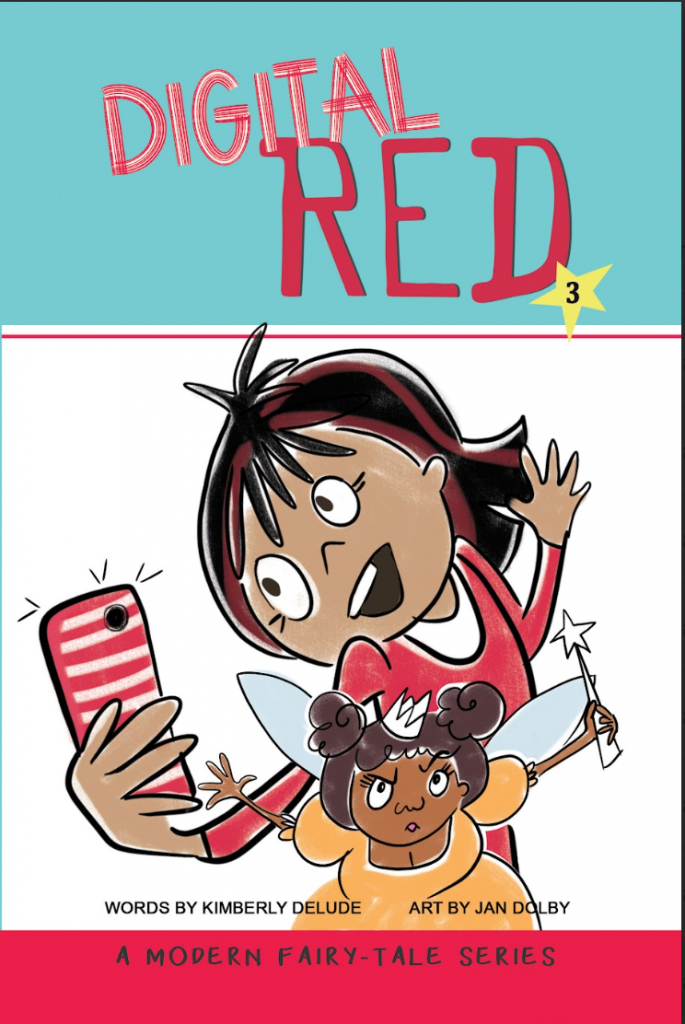
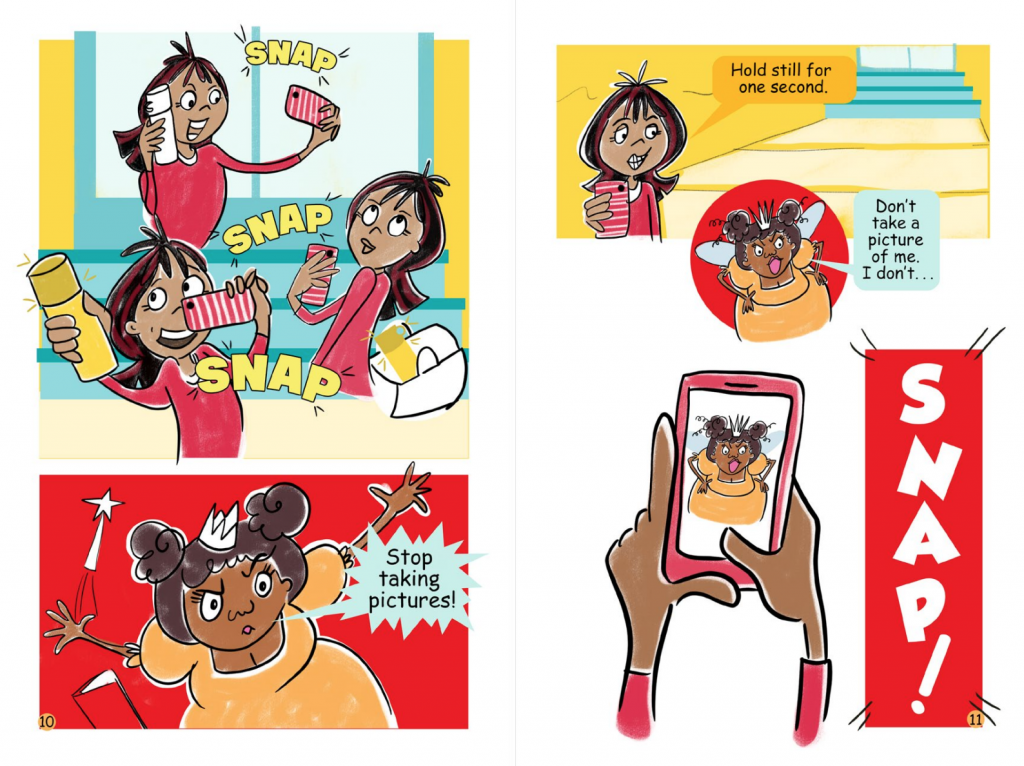
In Digital Red, our modern fairy-tale graphic early reader (book 3 in the series), humor builds through Digital Red’s gleeful defiance of her fairy godmother. The comedy isn’t just in the plot—it’s in the reaction. The fairy godmother’s exasperation over selfies and phone use delivers the laugh.
We already know that the Big Bad Wolf will kidnap Grandma. That familiarity gives us space to play. The humor is in the modern spin.
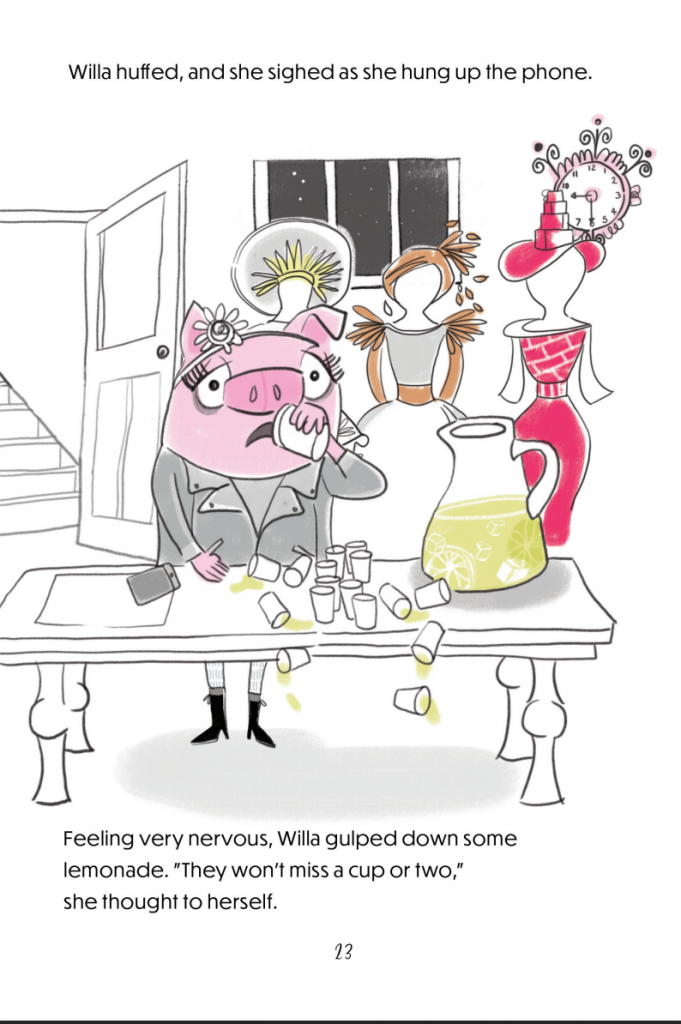
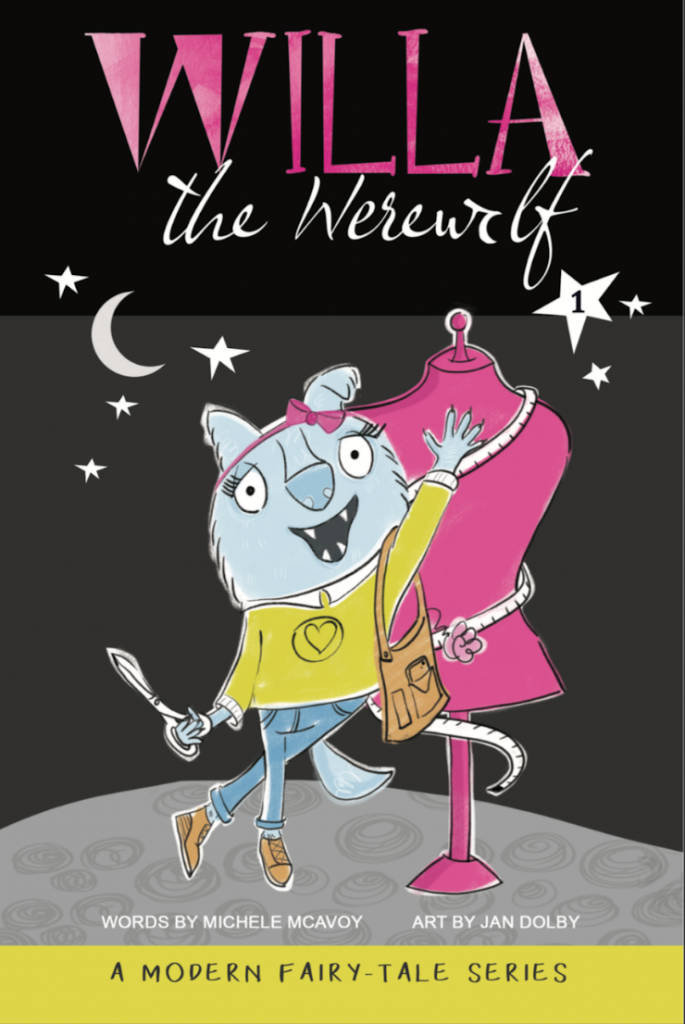
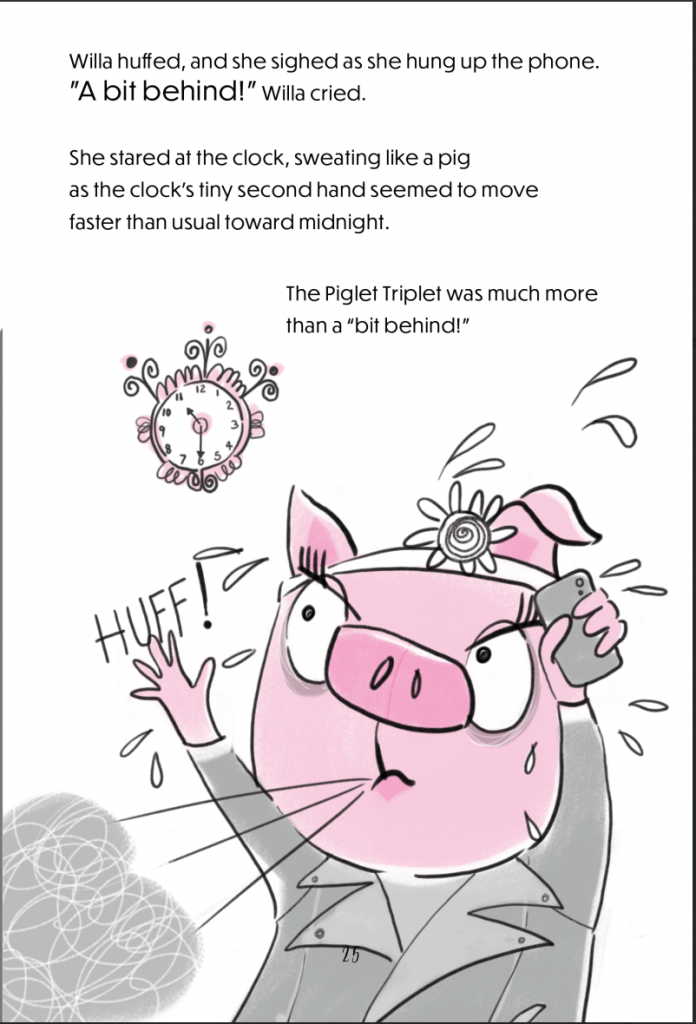
A similar comedic rhythm unfolds in Willa the Werewolf, our twist on The Three Little Pigs for which I am the author. There’s a visual timeline embedded in the illustrations that quietly escalates to a meltdown. The big reveal. The humor isn’t shouted—it simmers and pays off visually.
You’ll have to read it to see it. 🙂 Willa the Werewolf is book 1 in our modern fairy-tale series.
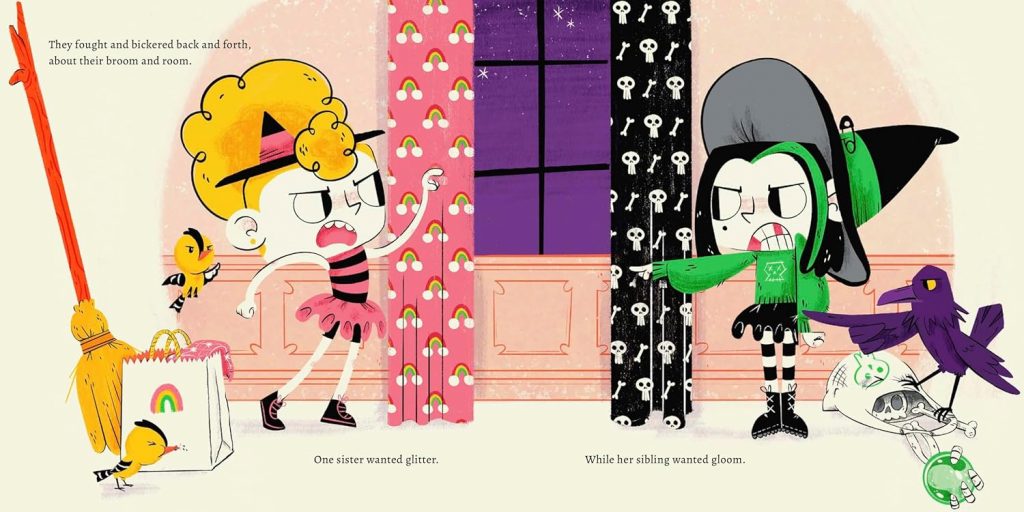
In Broommates: A Brewing Boundary Battle, the comedy takes another form. There’s a secondary backstory involving the sisters’ birds that unfolds entirely in the illustrations. It was added later in development, and it operates independently from the main narrative. That layered visual humor rewards the attentive reader.
Throughout the primary story, the funniest moment can be just a single beat—like when the “gloom” sister appears suddenly drenched in sparkle and bling. One turn of the page. One visual surprise. That’s the punchline.
And then there’s SKRUM.
SKRUM is pure physical comedy. It’s Saturday morning cartoon energy distilled onto the page. There aren’t isolated comedic beats so much as an ongoing crescendo of chaos. The humor doesn’t pause—it barrels forward.
There’s a big purple monster chasing a crotchety old man. Yes, there are moments that act as exclamation points, but the entire structure is built on over-the-top absurdity. It commits fully to the bit.
And that’s the point.
Humor in kidlit comes in all shapes and sizes. It can be sustained and outrageous, like SKRUM. It can arrive in understated, unexpected beats, like Digital Red. It can live in illustration, pacing, reaction, or restraint, like Broommates.
For me, the best humor is authentic to both the writer and the story. It entertains without trying too hard. It trusts the reader. It respects the rhythm of the page.
At the end of the day, a children’s book must entertain kids. But it also needs to delight the grown-ups who are buying it, gifting it, and reading it over and over again—if you’re lucky. Because when a book makes both child and adult laugh, that’s when the magic really happens.
Comment to Win!
Kidlit HaHa Week is giving away one copy of Digital Red (US ONLY)
To enter, let us know in the comments how your humor shows up. Does it shout, whisper, tumble across the page or slip in sideways (and what that looks like for you)? by April 7, 2026, 12pm ET.
Michele McAvoy is a multi-award-winning children’s book author, publisher, attorney, and educator from New Jersey. While Michele wears many hats, they all point towards a single goal, bring entertaining and meaningful stories to kids.
As a child, Michele read Judy Blume and drew Garfield comics. For her 10th birthday, she asked for a pink typewriter. Michele always loved the smell of new books. Now all grown-up (typewriters near obsolete) she loves bringing joy to children through her own stories. Michele’s published titles include Willa the Werewolf, Buckingham Gets A New Shell, Cookie & Milk, and Toby Undone.
Love this post!!! “I truly believe humor and entertainment are gateways to literacy.” I sat up straight and almost yelled “YES” out loud, but managed to hold it in to avoid frightening the cat.
I am taking to heart your advice on being authentic. Humor is subjective, so not everyone will like my style. But after reading your post, I feel empowered to stick to what I prefer even if some people don’t get it. If I have to define my style, I would call it absurd but sneaky.
I love this!sneaky humor is good humor.
I totally agree kids learn from humor! And they will return to books that make them laugh along with their parents and librarians. These are 4 great examples.
I really enjoy picture books that feature dry humor and absurd situations. But as a writer, that’s not my natural style. I use a lot of wordplay. Thanks for a thought-provoking essay!
Love these examples of different forms of humor in picture books! I believe my humor shows up in a shouting style. For me, the more chaos, the more absurd… the more fun 🙂
Love these examples of different forms of humor in picture books! I believe my humor shows up in a shouting style. For me, the more chaos, the more absurd… the more fun 🙂
Thank you for breaking down humor into bite size chunks. I appreciate it!
What a fabulous question. My humor whispers, deadpans, and is built in juxtaposition.
My humor shows up differently depending on the type of book I am writing. I love wordplay, but also appreciate the subtle approach. Most of my writing is based on interactions I have had with children, so sometimes my humor is outrageous. I love to hear children laughing. That is the motivating drive for me.
Nice to see so many different ways of getting humor to the page! I like the humor that sneaks in sideways with an intellect just above the reader’s grasp so they can enjoy getting it later.
Thank you for all this insight! I completely agree about humor being a gateway to literacy; my daughter fell in love with reading because of loud & outrageous picture books we read together everyday, and I saw kids loving to laugh and make reading into a full experience when I was a library storytime educator. It’s also why I enjoy writing humor. I love when my humor shouts right through the 4th wall to the reader, sneaks up unexpectedly, and sprinkles puns throughout!
I agree humor comes in all shapes and sizes. I have never attended a live comedy show because only certain types of humor make me laugh. As a child I loved slapstick humor like The Three Stooges and goofy, good-natured humor like Carol Burnett and I Love Lucy. My humor can be punny, making you groan as you laugh. It can also be shown in exaggerated characterizations where a character, especially an animal, is just over the top. Writing humor makes me smile inside. I hope it causes smiles, giggles, chortles, and guffaws from my readers.
Loved this post. As a kid, I enjoyed Looney Tunes. Now, I find sarcasm and being a bit snarky from time to time funny, so I wrote a book told from the POV of one of Cinderella’s stepsisters, who claimed Cinderella wasn’t very nice. My writing, like me, is a work in progress.
100% this –> “When children laugh, they lean in.
When they are entertained, they turn the page.
And when they turn the page, they are reading—joyfully, willingly, and often repeatedly.”
You nailed it, Michele. This is gold.
My humor style ranges from word play (puns, onomatopoeia, made-up words, etc) to playful antics, with the occasional bit of slapstick or physical comedy. My current WIP throws in a few subversive twists, too. No matter what I write, I love reading it aloud (or having someone else read it) to make sure the page turns work just right.
Thanks for your article! 🙂
This was a wonderful post. My humor can be ridiculous, subtle and sometimes dark. If I laugh as I’m writing it then I hope it will make others laugh too. I’m blessed to have Michele as the editor of my humorous debut picture book this October.
Thank you for this fabulous post. If someone described me as witty, it would be the ultimate compliment. I go for humor with a side of heart. Hopefully if I’ve done it correctly, you’re giggling so much you don’t see the sweetness come up and hit you in the gut. It’s such a thrill when it works!
Thank you for this wonderful post. I’ve always been funny according to friends and family. My critique partners have definitely laughed out loud at manuscripts through multiple readings in places where there’s humor and it worked. My funny writing is not subversive or mean. It rests more where humor meets heart and it comes organically in the story. I’ve never been revising and thought, ‘I could use a joke here’ which is what you’ve warned against.
I have a manuscript I’m working on now that needs an ending and I had a conversation with another author about a few ideas and one was kind of dark. She said, that doesn’t sound like you. I said it doesn’t sound like a picture book I would write. Maybe for an older audience. I think that’s because when I worked with young children they needed me to lead with my heart and I’ve maintained that as a writer. I can be funny and heartfelt.
I tend to have sarcasm or subtle hints of humor running through the background. A line here or there that coincides with the main point and text. I am excited to read Digital Red! Twists on classics are a great way to hook kids, too. Thanks for the post!
“I truly believe humor and entertainment are gateways to literacy. ” Well said, Michele! I’m a former primary classroom teacher and reading specialist. I agree completely! I have seen it in action. I’m familiar with The Little Press and your publications. You have a good thing going. My writing humor is sometimes sneaky-slips in sideways, but mostly it shouts. As a reader, I haven’t met an in-your-face humorous book I didn’t love!
Thanks for a wonderful post.
As a reading mentor, I can attest to your statement that humor and entertainment are the gateways to literacy. The kids pick their own books and they are nearly always something funny. My own humor shows up on the page mostly as word play, with some slapstick thrown in.
MICHELE: I’m LOVING all your books from The Little Press! I TRULY APPRCIATE the view you’ve given us from both a writer and an editor. I can TOTALLY relate to your INSPIRATION as an 80’s child; many of my FAVORITES are on your list! Like you, I have been described as having witty, unexpected humor. I also learned from a young age to be QUICK AT THE DRAW with sarcasm, in order to do battle with a MAJOR TEASE uncle. I guess my humor comes through in different ways, for different stories. But it’s what the story calls for, without me trying to force it (hopefully!).
I never noticed the birds in Broommates! I love details like that. I’ll have to check it out again! My humor peeks through an open door to check whether anyone is in the room before pouncing on the unsuspecting reader. 🙂 Which is to say that I think my humor comes in the form of a logical premise that progressively grows more unhinged as the sentence/story goes on.
My humor usually ends up dry supported by silly illustrations. I love the idea of thinking of humor in terms of sitcoms. Thank you!
Love your humor! Being genuine is definitely key! There’s a humor category for everyone! 🤣
Enjoyed this post. My humor shows up ( when it does . My students think I’m funny. My husband says I’m not) my humor is through language …and timing. The unexpected word play at the right moment!
My humor definitely whispers and often relies on the illustrations to contradict the narrator. Thanks so much for looking at the different ways humor can show up, but also for reminding me to be true to my own sense of humor.
Yes, there are many types of humor–and kids love funny books! My humor comes in different forms, depending on the story–and I try to slip in a little heart, too–my favorite combination.
My humor is almost never in-your-face, although I do enjoy those books! It’s more sarcastic, ironic, or clever. I think I mostly enjoy taking something completely ordinary and mundane and looking at it in a hilarious new way. I just love experimenting with perspectives. Thank you for sharing your appreciation for humor and its impact on young readers!
Love the glitter and gloom sisters! Thank you!
Thanks for this great post! I enjoyed reading about the different types of humor, and agree that it must always be authentic. My style of humor in writing, and in life, is a mixture of witty, silly, and slapstick. I also love wordplay, and always appreciate a good pun. 😊🤣
I resonate with so much in this blog. AND I have been surprised when people say I’m funny, too!
Love this take on different forms of humor. In real life my humor is quiet, witty, and sarcastic… pinprick jab when you don’t expect it. I’m still figuring out how that translates onto the page.
Thanks for this reminder that I can write my own brand of humor and don’t need to try and mimic anyone else.
Thank you for sharing! I enjoyed looking at each of the books you mentioned and their style of humor. I love the bold outrageous humor at times, but also the kind of humor that sneaks up on you as well. It’s fun to hear the laughter of a child reading and know that book will become one of their favorites because of the well placed humor by the author.
Thanks for this post on humorous picture books. And thanks for the mentor texts to read and “pull apart”! Sometimes people tell me I’m funny but I have the darndest time getting funny on paper! This is certainly going to help my dull sense of pencil funny!